


Eating disorders are complex mental health conditions, yet many misconceptions about who experiences them, what they look like, and how recovery works continue to persist. These myths can contribute to stigma, delay recognition of symptoms, and make it harder for individuals to seek appropriate support.
As a certified eating disorder recovery coach who has fully recovered from an eating disorder, I’ve encountered many of these misconceptions in both my personal and professional experiences. Some are widely recognized, while others are so normalized that people may not realize they’re inaccurate.
From the belief that someone must be visibly underweight to have an eating disorder to the assumption that full recovery isn’t possible, these misconceptions deserve to be challenged.
Below, I’m breaking down 14 common myths about eating disorders, exploring what the research tells us, and sharing insights from my experience supporting individuals through recovery.
1. Only white women struggle with eating disorders.
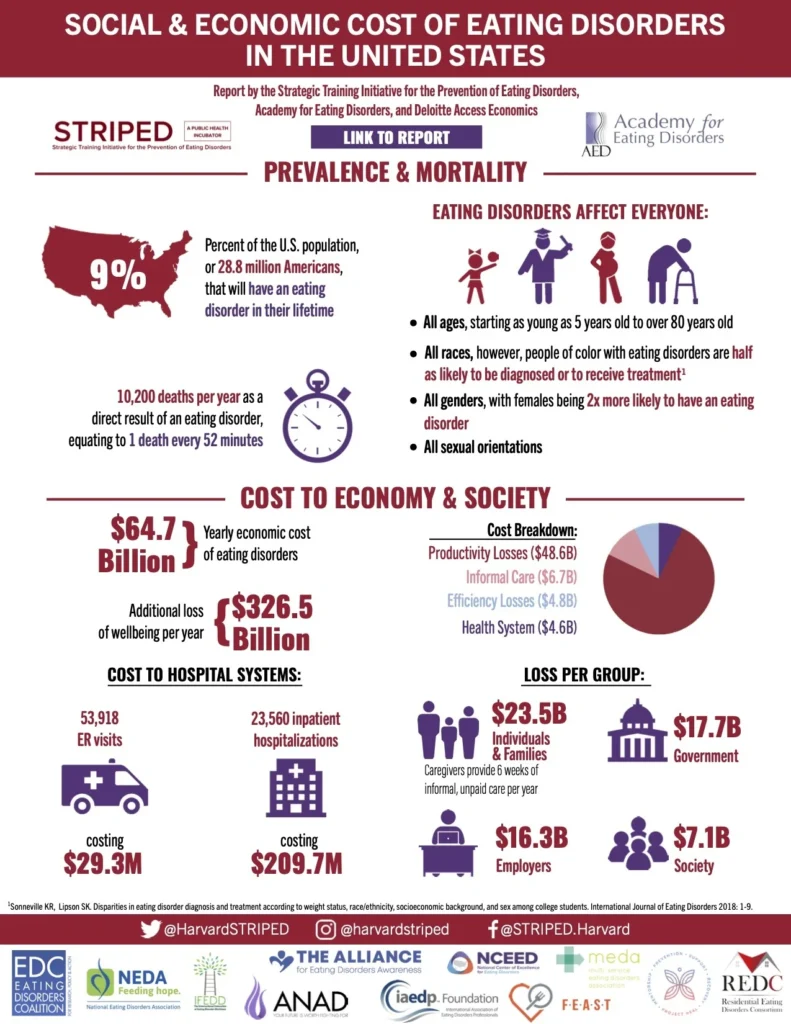
People of all races struggle with eating disorders. For so long, only white women have been portrayed as having eating disorders in the media, even though this is hardly an accurate representation. And according to STRIPED, people of color with eating disorders are half as likely to be diagnosed or to receive treatment.
Alishia McCullough is a licensed clinical mental health therapist and author of Reclaiming the Black Body. Her book dives into the overlooked impact of disordered eating among Black women. Her work validates the lived experiences and generational traumas of BIPOC communities. Order Reclaiming the Black Body here!
2. You need to look emaciated to struggle with anorexia. If you appear to have a “normal weight” or “normal body type,” you cannot have an eating disorder.
Less than 6% of people struggling with an eating disorder are medically underweight, according to the Journal of the American Academy of Child & Adolescent Psychiatry. This is often one of the biggest reasons that my clients don’t want to share their struggles with friends, as there is such a strong misconception that being a normal body weight means that you’re “okay.” This is just one of the common myths about eating disorders that create barriers for people seeking help.
Because eating disorders don’t always involve visible physical changes, recognizing other warning signs is important. I’ve outlined additional behaviors and emotional changes to look for in my article, 15 Early Signs of Eating Disorders.
3. If You Don’t Meet the Criteria for Anorexia or Bulimia, You Don’t Have a Serious Eating Disorder.
Eating disorders don’t always fit neatly into the diagnostic categories people are most familiar with. Other Specified Feeding or Eating Disorder (OSFED) is a recognized diagnosis that applies when someone experiences clinically significant eating disorder symptoms but doesn’t meet the full criteria for another specific eating disorder diagnosis.
OSFED can involve serious psychological distress, physical health consequences, and disruptions to everyday life. Not meeting the diagnostic criteria for anorexia nervosa or bulimia nervosa doesn’t mean someone’s symptoms are less significant or that they don’t deserve treatment.
The severity of an eating disorder cannot be determined by its diagnostic label alone. Anyone experiencing concerning eating behaviors, distress around food, or other potential symptoms deserves an appropriate professional evaluation.
For more information about eating disorder diagnoses and symptoms, the National Institute of Mental Health provides an overview of recognized eating disorders and available treatment options.
4. Only young women struggle with eating disorders.
Here’s another one of the common myths about eating disorders that we need to challenge: eating disorders affect individuals of all genders, not just women. While research from STRIPED shows that females are twice as likely to struggle with an eating disorder, it’s crucial to recognize that men also face these challenges. In fact, I’ve personally had numerous men reach out for coaching services, highlighting that eating disorders are not gender-specific.
Men, too, can experience the same struggles with body image, disordered eating, and the emotional toll these conditions take. It’s vital to continue to break the stigma surrounding men and eating disorders so that all individuals, regardless of gender, feel empowered to seek help and support.
5. Only wealthy people struggle with eating disorders.
People of all socioeconomic statuses can struggle. Eating disorders don’t discriminate. According to the article Diseases of affluence? A systematic review of the literature on socioeconomic diversity in eating disorders, “There is no consistent pattern of evidence to suggest a relationship between high SES and ED.”
In addition, according to the article Household food insecurity is associated with binge-eating disorder and obesity from the National Library of Medicine, food insecurity is associated with binge eating disorder, and those with a history of childhood food neglect are more likely to have binge eating disorder, bulimia nervosa, or anorexia nervosa than those without childhood food neglect
6. Eating disorders begin with body dissatisfaction (body image concerns).
Eating disorders don’t always begin with body dissatisfaction. Sometimes it can be due to a lack of interest in eating, a response to a trauma that occurred, difficulty tolerating emotions, etc. In my experience working with many different clients, body dissatisfaction can be a factor but it is not always the biggest issue my client is facing. Everyone has their own unique struggles.
7. Binge eating disorder means you’re out of control around food.
If you are struggling with binge eating disorder, I want you to know that you do not lack self-control. There are many different treatment options for you, and Cognitive Behavioral Therapy with a licensed therapist can be super helpful. Additionally, you may find relief from the feelings of shame by attending a support group. Everyone is different and different treatment options exist!
8. Full recovery is not possible, only lifetime maintenance.
I am fully recovered from an eating disorder, and I personally know many people who are fully recovered as well. We do not have any research or evidence that proves there are specific people who are incapable of achieving full recovery. However, this does not mean that is everyone’s goal. If your recovery goals look different than full recovery, that’s ok too.
Motivation can fluctuate throughout recovery, and that’s a normal part of the process. For practical ways to navigate those moments, explore my guide on finding motivation in eating disorder recovery.
9. You need to meet diagnostic criteria in order to struggle with an eating disorder.
I have worked with plenty of clients who have not had a formal diagnosis of an eating disorder, but it was very apparent to both me and their team that they were struggling. It is important to note that not everyone has access to see a provider and receive a formal diagnosis. Your struggle is valid no matter if you have a formal diagnosis or not.
10. Family members should always be involved in treatment.
Family Based Treatment can sometimes be recommended for adolescents struggling with eating disorders. Each situation is unique, and family does not necessarily need to be involved in order to achieve recovery goals. In fact, I have worked with a number of adults who did not want family involved in their treatment and they were able to independently achieve recovery goals with the help of their team.
Treatment decisions should reflect each person’s circumstances, needs, and support system. I explore this further in my article about individualized eating disorder treatment.
11. Purging Only Means Self-Induced Vomiting.
When people hear the word “purging,” they often think exclusively of self-induced vomiting. However, purging can also involve the misuse of laxatives, diuretics, or other methods intended to influence weight or shape.
It’s also important to distinguish purging from other compensatory behaviors. Someone may engage in excessive exercise or fasting in an attempt to compensate for eating. Although these behaviors aren’t typically classified as purging, they can still be associated with eating disorders and carry serious physical and psychological risks.
Not everyone with an eating disorder engages in purging or compensatory behaviors, and their absence doesn’t make an eating disorder any less deserving of professional attention.
The National Alliance for Eating Disorders explains the distinction between purging and non-purging compensatory behaviors, including their potential physical health consequences.
12. Avoidant restrictive food intake disorder (ARFID) means you’re a picky eater.
There are a plethora of reasons that ARFID and picky eating are different. Those with ARFID can have a lot of difficulty meeting their nutritional needs due to sensory sensitivities, a lack of interest in food, and feeling anxious about the consequences of eating like vomiting or choking. ARFID is a serious mental illness, and if you are struggling with it, your struggle is valid and you deserve to get the treatment that you need.
As we continue to challenge these common myths about eating disorders, it’s essential to remember that no two cases look alike, and recovery is a deeply individual journey.
13. You Can Tell How Severe Someone’s Eating Disorder Is by Looking at Them.
One of the most harmful misconceptions about eating disorders is that someone’s physical appearance reflects how much they’re struggling. In reality, eating disorders can affect people at any body size, and the seriousness of someone’s condition cannot be determined by appearance alone.
Someone may appear physically healthy while experiencing significant psychological distress, nutritional deficiencies, or medical complications. Similarly, weight changes aren’t the only indication that an eating disorder may be affecting someone’s health.
In my work as an eating disorder recovery coach, I’ve encountered individuals who question whether they deserve support because they don’t fit the stereotypical image of someone with an eating disorder. This misconception can contribute to delayed help-seeking and reinforce the belief that someone must become visibly unwell before their struggles are taken seriously.
Eating disorders deserve professional attention regardless of how someone looks.
14. Older adults will not get better.
This can be one of the most harmful, yet common myths about eating disorders. There are plenty of older adults who have achieved full recovery later in life. I have also personally worked with people in their 50s and 60s who have achieved major success in recovery.
Moreover, no matter how old you are, recovery is possible!
Conclusion: Common Myths about Eating Disorders Officially Debunked
In conclusion, common myths about eating disorders persist, often making it harder for individuals to seek help or recognize their struggles. These misconceptions—about who can be affected or what recovery looks like—stem from a lack of understanding. By challenging these myths, we can create a more inclusive and supportive environment for those in need. It’s important to remember that eating disorders do not discriminate based on gender, age, race, or body type, and recovery is possible at any stage of life.
If you or someone you know is struggling, resources like the National Eating Disorders Association (NEDA) offer valuable support. Lastly, let’s continue to educate ourselves, break the stigma, and ensure everyone has access to the help they deserve.
Looking for Additional Support in Eating Disorder Recovery?
Understanding the facts about eating disorders is an important step, but navigating recovery often involves putting that knowledge into practice. Through one-on-one eating disorder recovery coaching, I offer personalized, non-clinical support to help individuals build recovery skills, navigate everyday challenges, and work toward their recovery goals.
Published by Merrit Elizabeth on Nov.11, 2024. Last updated November 5, 2026.

Merrit Elizabeth Pacheco is an Eating Disorder Recovery Coach certified by The Carolyn Costin Institute. She holds a master’s degree in Health Promotion Management and a certification in Applied Neuroscience. With many years of experience, she has worked with hundreds of clients, parents, and treatment team members to support lasting recovery. Fully recovered herself, she combines professional training with lived experience to help women rebuild trust, confidence, and freedom around food and body.

read or leave a comment +
Hide Comments –